 Ziduri

Ephemera: an encrypted room, a code, and a conversation that leaves nothing behind
Create a short-lived room and exchange end-to-end encrypted text and images with someone in real time — no account, no message history, nothing saved once the room is gone. The server relays ciphertext it can't read.
Ephemera is an early-stage MVP capped at 3 active rooms system-wide. Messages are end-to-end encrypted, but there's no identity verification beyond comparing safety codes — see the FAQ below before relying on it for anything sensitive.
Sometimes you just need to send one thing, once
Signing up for a messaging app, or emailing yourself a file, is a lot of ceremony for a single quick exchange. Ephemera skips all of it: open the page, create a room, share the code, and start talking. When you're done, close the tab — there's no account to delete because there was never one to begin with.
What Ephemera does
End-to-end encrypted
Devices agree on an AES-256-GCM key via ephemeral ECDH, negotiated over the relay. The server only ever handles ciphertext — it cannot read your messages or images.
Instant rooms
Create a room and get a short code immediately — no form, no account.
Join by code or link
Share the room code, or a direct /r/<room-id> link that auto-joins.
Real-time text and images
Messages and images up to 2 MB deliver instantly over a live WebSocket connection.
Image preview & download
Click a shared image to open a full-view preview, then copy or download it.
Nothing persisted
No database, no message history — content exists only for the life of the room.
Self-cleaning rooms
A room clears out roughly 2 minutes after the last participant leaves.
Safety code verification
Both devices show a short code derived from the agreed keys. If they match, nobody intercepted the handshake.
Who Ephemera is for
Quick cross-device handoff
Send yourself a link, snippet, or screenshot from your phone to your laptop without an app.
A throwaway chat with someone new
Talk to someone without exchanging phone numbers or usernames — share a code, then it's gone.
One-off image sharing
Send a photo or screenshot to someone nearby in real time, with nothing left behind afterward.
From open tab to conversation
Create a room
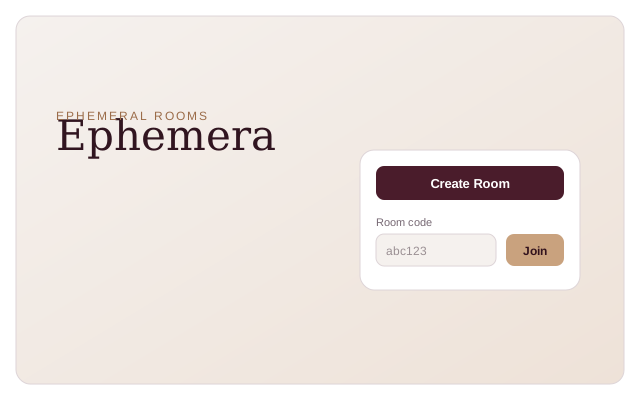
Open Ephemera and click Create Room to get a short room code.
Share the code
Send the code or the room link to whoever you want to talk to.
Compare the safety code
Both devices negotiate an encryption key and show a short safety code. Matching codes confirm the exchange wasn't intercepted.
Talk in real time
Exchange end-to-end encrypted text and images instantly — everyone in the room sees them live.
It disappears
Close the tab. The room cleans up on its own a couple of minutes after everyone leaves.
What Ephemera accesses, and why
As a web app, Ephemera doesn't install anything on your device. See the privacy policy for the full picture.
| Capability | Why it's used |
|---|---|
| End-to-end encryption (WebCrypto) | Each browser generates an ephemeral ECDH key pair and derives a shared AES-256-GCM key with the other device, using the browser's built-in Web Crypto API. Keys are never sent anywhere and never stored. |
| WebSocket connection | Delivers end-to-end encrypted message envelopes between everyone currently in your room, in real time. The server relays ciphertext it cannot read. |
| Clipboard (optional) | Only used if you click "copy" on a shared image — never accessed automatically. |
| Room registry storage | Server-side only: tracks which room codes currently exist and whether the system is at its 3-room capacity. Never stores chat content or encryption keys. |
| Accounts / sign-in | Not used. There is no login anywhere in Ephemera. |
Frequently asked questions
Do I need an account to use Ephemera?
No. Create or join a room with just a room code — there is no sign-in, no email, and no password.
Are Ephemera messages end-to-end encrypted?
Yes. The two devices in a room agree on an AES-256-GCM key by ephemeral ECDH (P-256), negotiated over the relay. The server only ever sees ciphertext and public key material — it cannot decrypt your messages or images, and the protocol itself rejects plaintext messages. Both devices show a short safety code; compare it to confirm nobody intercepted the key exchange.
What's the safety code, and what happens if the two don't match?
It's a short code both devices derive from the encryption keys they just agreed on. If a relay tried to substitute its own keys during the handshake, the two safety codes would differ — that's the whole point of showing it. Ephemera doesn't force this check, so compare the codes yourself (read one aloud, or look at both screens) before treating the room as verified. If they don't match, leave and create a new room.
Does Ephemera save my messages?
No. Messages and images are relayed live between participants and are not written to any database or persistent storage. Once a room expires, there is nothing left to recover.
What happens if I lose my room code?
There is no recovery. Ask another participant still in the room for the code, or create a new room. This is by design — recoverable rooms would require persistent storage or accounts, which Ephemera deliberately avoids.
Why does it say the app is at capacity?
Ephemera currently allows a maximum of 3 active rooms system-wide, since it's an early-stage MVP. Wait for a room to expire (rooms clean up a few minutes after everyone leaves) and try again.
More resources
Documentation, release notes and privacy details.
More from Ziduri
 Browser Extension
Float Note
A translucent floating note editor that saves notes per page, right in your browser.
 Desktop Application
LiteView
A ~2 MB image viewer for Windows 10/11, Linux and macOS 13+ that opens SVG, WebP and AVIF through each platform's web engine.
 Web App
Anon Postal
Publish a public post with no account, or sign in for a private workspace with a custom expiry.
 Desktop Application
MarkDW
A very lightweight markdown viewer and editor for desktop, with an optional browser mode.